 blog
Best Used SUV Models for Families: 2026 Guide
Table of Contents
- How to Choose the Best Used SUV Models for Families
- Most Reliable Used SUVs for Family Duty
- Best Budget-Friendly Used SUVs for Families
- Best Used Three-Row SUVs for Families
- Passenger Space, Cargo Capacity, and Safety by Model Year
- Used SUV Buying Checklist Before You Sign
- Ownership Costs and Financing a Family SUV
- Frequently Asked Questions
Last Updated: October 20, 2026
How to Choose the Best Used SUV Models for Families
Finding the best used SUV models for families comes down to three things: proven reliability, real passenger and cargo space, and a total cost you can live with. At Hillside Motors, we've helped Southern Tier families sort through those trade-offs for years.
It's the one that fits your car seats, your commute, and your budget at once. Below, we'll cover the SUV classes worth considering, which used models hold up, and the inspection steps that separate a good buy from an expensive mistake.
Quick Comparison: Family SUV Types at a Glance
Three vehicle classes cover most family needs. Here's how they stack up before you start shopping.
Class | Seating | Best For | Trade-Off |
|---|---|---|---|
Compact SUV | 5 | Small families, tight parking, daily driving | Limited cargo with rear seats up |
Midsize SUV | 5-7 | Growing families, road trips | Higher purchase price |
Three-row SUV | 7-8 | Larger families, carpool duty | Heavier, thirstier, harder to park |
A compact SUV is a crossover built on a car platform, keeping fuel economy reasonable and handling predictable.
For most two-child families, a midsize SUV hits the sweet spot. Families with three or more kids, or regular carpool duty, should start with three-row models.
Most Reliable Used SUVs for Family Duty
Reliability is the single biggest factor in used SUV value. A dependable vehicle keeps your repair budget predictable, which matters more than any feature list.
A common mistake is assuming a brand's reputation applies to every model year. Before you commit, check the NHTSA recall and complaint database for the specific year you're considering, and read complaints by component rather than by total count.
Model families that consistently earn family-duty recommendations
These are the nameplates independent mechanics, reliability surveys, and long-term owner reports most often put at the top of the used family SUV list. Treat them as starting points, not guarantees, because condition and service history still decide the individual vehicle.
- Toyota Highlander (midsize, three-row): Long production runs with few major redesigns mean parts are plentiful and independent shops know the platform. The hybrid version has a strong record for battery longevity, but have the battery cooling system and hybrid components inspected on higher-mileage examples.
- Honda Pilot (midsize, three-row): Roomy second and third rows and a reputation for durable engines. Earlier generations of the automatic transmission are the item to scrutinize; later years improved. Check for transmission service records and test for smooth, decisive shifts.
- Toyota RAV4 (compact): One of the most common used family crossovers for good reason: strong dependability record, easy parts availability, and a hybrid option that holds value. Inspect for rust in states that use road salt and confirm the hybrid battery has been serviced.
How to verify reliability on the specific vehicle
Reliability also depends on how the previous owner treated the vehicle. A well-documented maintenance history on a mid-tier model usually beats a spotty history on a premium one. Look for:
- Consistent oil change records at the recommended intervals
- Evidence of scheduled transmission and coolant service
- No gaps of a year or more in the service log
- Completed recall repairs, confirmed through the NHTSA recall lookup
Japanese and Korean brands generally have the strongest dependability records in the used market, with several American and European models close behind in specific years. Read the vehicle history report line by line, then have an independent mechanic confirm the mechanical story the paperwork tells.
Best Budget-Friendly Used SUVs for Families
Affordability in a used family SUV means more than a low sticker price.
Older compact and midsize SUVs from mainstream brands are the value sweet spot: most depreciation is absorbed, parts are widely available, and independent shops know them well.
Hillside Motors focuses on exactly this kind of dependable, budget-conscious inventory, and we help buyers with challenged credit, limited credit history, or a past bankruptcy find financing that fits.
Three costs to weigh beyond the sticker:
- Fuel economy: A smaller engine or a hybrid powertrain can save real money over years of commuting.
- Insurance: Sport trims and larger engines often carry higher premiums.
- Tires and brakes: Larger SUVs cost more to keep road-ready.
Best Used Three-Row SUVs for Families
Three-row SUVs are the workhorses of larger families: they carry seven or eight passengers, handle carpool duty, and swallow a week's worth of luggage. The trade-off is size, weight, and fuel consumption.
When comparing used three-row SUVs, focus on the third row's actual usability rather than its existence.
Third-Row Space and Child-Seat Fit
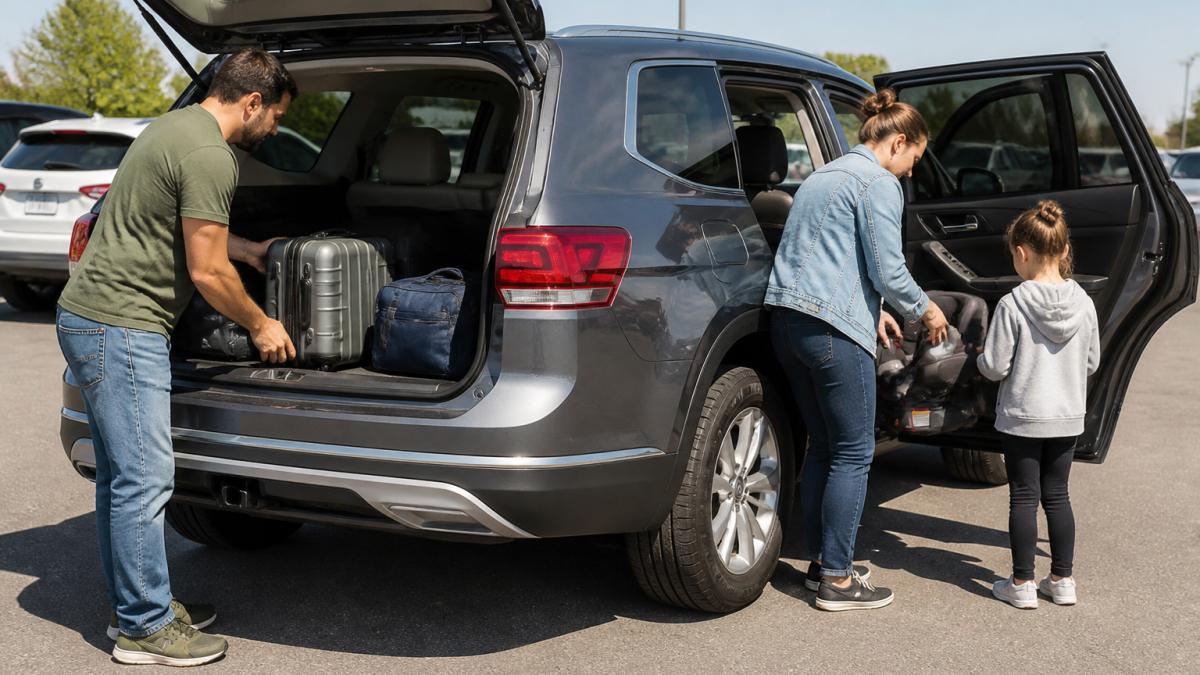
Child-seat fit is where three-row shopping gets practical. Look for easy-to-reach second-row LATCH anchors, and check whether a rear-facing seat fits without pushing the front passenger seat uncomfortably forward.
Bring your own car seats to the test drive. Install them in the positions you'd actually use. This single step catches more family-usability problems than any spec sheet.
Passenger Space, Cargo Capacity, and Safety by Model Year
Evaluate space and safety together, because both change by model year within the same nameplate.
For safety, check two sources for the exact year you're considering: the NHTSA safety ratings and the IIHS crash test results.
On space, measure what you actually carry. Stroller, sports gear, groceries, and a dog all compete for the same cargo area. Fold the third row and check the load floor.
What to Check | Why It Matters |
|---|---|
Second-row LATCH anchors | Easier, safer car-seat installation |
Third-row legroom and headroom | Real usability for older kids |
Cargo space with all rows up | Daily errands and school runs |
Cargo space with rows folded | Road trips and large loads |
Standard safety features by year | Crash protection varies by model year |
Used SUV Buying Checklist Before You Sign
A used SUV buying checklist protects you from the two most common regrets: hidden mechanical problems and surprise fees. Run through this before any money changes hands.
- Pull the vehicle history report and confirm no salvage or flood title
- Verify the mileage against service records and the report
- Check the NHTSA recall lookup and confirm open recalls were repaired
- Have an independent mechanic perform a pre-purchase inspection
That last point matters. Buyers who've been burned elsewhere often ask what's really included in the advertised price. Get the full breakdown in writing so the final number matches what you were quoted.
Ownership Costs and Financing a Family SUV
Ownership costs decide whether a used SUV is genuinely affordable. Purchase price is only the first number: fuel, insurance, maintenance, repairs, and registration add up every year, and a cheaper vehicle with poor fuel economy can cost more over five years than a slightly pricier efficient one.
The five cost buckets to estimate before you buy
Build a simple annual estimate for each candidate using these buckets. Use your real commute mileage, not the highway rating, and get insurance quotes for the exact make, model, trim, and year.
- Fuel: Multiply your price per gallon times Annual miles divided by MPG to get your annual fuel costs. A compact crossover that returns mid-20s combined mpg will typically cost noticeably less per year than a V6 three-row that returns high teens, at the same mileage.
- Insurance: Premiums vary by trim and engine. Sport trims and larger engines often carry higher premiums; safety features like automatic emergency braking can lower them on newer years. Get three quotes before you decide.
- Maintenance: Budget for oil changes, tires, brakes, fluids, and filters. Larger SUVs use larger, more expensive tires and brake components. A maintenance reserve set aside monthly prevents a single repair from derailing the family budget.
- Repairs: Older and higher-mileage vehicles need a larger buffer. Ask the seller for the last two years of repair receipts and assume some of the same pattern will continue.
Model-by-model cost patterns to expect
Exact dollar figures depend on your location, driving, and the individual vehicle, so treat these as relative patterns rather than quotes. The pattern is consistent across most markets:
- Compact crossovers (RAV4, CR-V, CX-5): Lowest fuel and tire costs of the family classes, and the widest parts availability. Insurance is usually moderate. These are typically the cheapest family SUVs to run year over year.
- Midsize three-row SUVs (Highlander, Pilot, Sorento): Higher fuel use and larger tires raise the annual cost, but parts are still widely available and independent shops know them. Hybrid versions can offset some fuel cost, provided the battery is healthy.
- Full-size SUVs: Highest fuel, tire, and brake costs of the group. Only worth the premium if you regularly use the towing capacity or need eight seats.
- Hybrid and plug-in hybrid models: Fuel savings are real but depend on your driving mix and charging access. Have the high-voltage battery inspected, and confirm remaining battery warranty coverage before you buy.
Financing without surprises
Financing deserves the same scrutiny as the vehicle. Hillside Motors works with multiple financing sources, including Credit Acceptance and local credit unions, to help customers with excellent credit, challenged credit, limited credit history, and previous financial difficulties.
Before you sign, ask for four numbers in writing: the annual percentage rate, the term in months, the monthly payment, and the total you'll pay over the life of the loan.
Frequently Asked Questions
Which used SUV is the most reliable to buy for a family?
Reliability depends more on the specific model year and maintenance history than on the badge. Look for mainstream compact and midsize crossovers from Toyota, Honda, Subaru, and Kia that have documented service records and no major open recalls. Ask for the vehicle history report, confirm the timing belt or chain service interval, and have a pre-purchase inspection done by an independent mechanic. A well-maintained two-owner SUV with 90,000 miles often beats a neglected one with 50,000 miles. At Hillside Motors, you can request the history for any used SUVs for families on the lot.
What should I check before buying a used family SUV?
Run through a used SUV buying checklist: pull the vehicle history report for accidents and title brands, verify recall repairs were completed, test every seating position and latch a child seat in the second and third rows, check cargo space with your stroller or gear, and take a test drive on both highway and rough pavement. Have an independent mechanic inspect the brakes, tires, suspension, and fluid condition. Confirm the out-the-door price in writing, including taxes and fees, so the final number matches what was advertised.
Are used three-row SUVs a good choice for families?
Yes, if you regularly carry five or more people. Three-row SUVs give you a third row for kids or occasional adult passengers and fold-flat cargo space when the extra seats are not needed. The trade-offs are higher purchase price, more weight, and lower fuel economy than a two-row crossover. Check third-row legroom and how easily the second row slides forward for access. If your family is four or fewer, a spacious two-row midsize SUV usually costs less to buy and run.
What is the best budget-friendly family SUV to buy used?
Compact and midsize crossovers from mainstream brands typically offer the best value: lower purchase price, cheaper parts, and strong fuel economy. Prioritize models with a documented service history over the lowest sticker price, because repair costs can erase the savings. Factor in insurance, tires, and expected maintenance when comparing. Financing terms also affect the real budget, so get pre-approved and compare the total cost, not just the monthly payment. Hillside Motors works with multiple lenders, including options for challenged credit, to help match a payment to your budget.
Choosing a used family SUV is a balancing act between reliability, space, safety, and cost, and getting it right takes more than a quick test drive. At Hillside Motors, we inspect our inventory carefully, share transparent vehicle histories, and help buyers at every credit level find financing that fits. Browse our selection online, apply for financing, and schedule a test drive to find dependable transportation for your family.